



Have you ever marveled at the ethereal sunbeams piercing through the misty air? What about when watching a film noir antagonist appear in a tunnel? Or a character walks through a video game that seems to sparkle in mystery? These captivating visuals result from a lighting technique with many aliases: crepuscular rays, ray tracing, atmospheric lighting and volumetric lighting. But what exactly is this effect and why has it become an indispensable tool in various artistic fields?

Volumetric lighting is a term used mainly in film and video graphics. At its core, the term refers to the illumination of particles in the air. The technique creates visible cones of light, often appearing solid and tangible. Originating from the theatrical medium of suspended particles, such as dust, smoke or haze, to scatter and reflect light.
Nature is a master of creating breathtaking volumetric lighting displays and understanding these natural occurrences can provide valuable insights into the mechanics of these techniques.
Table of Contents:
- Lighting filtering through the atmosphere
- Crepuscular rays and architectural illumination
- Dust, smoke and haze: Nature’s atmospheric canvas
- Artistic applications of volumetric lighting
- Why employ atmospherics and lighting effects
- Creating volumetric lighting
Light filtering through the atmosphere
The Earth’s atmosphere is a complex mixture of gasses, water vapor and microscopic particles, collectively known as aerosols. As sunlight traverses the atmosphere, it interacts with these particles, producing optical effects, including the scattering and absorption of light rays.
This interaction is responsible for the vivid hues during sunrise and sunset, as well as the ethereal quality of light beams penetrating through the haze or fog.

The longer wavelengths of light, such as reds and oranges, are less scattered by atmospheric particles, while shorter wavelengths, like blues and violets, are more readily dispersed. This scattering creates the warm, golden hues that paint the sky, transforming ordinary moments into extraordinary visual experiences.
Crepuscular rays and architectural illumination
One of the most captivating manifestations of volumetric lighting in the natural world is the phenomenon of crepuscular rays. Also known as “God rays” or “sunbeams.” These distinct shafts of light appear to radiate from the sun when its rays pass through gaps in clouds or other obstructions, such as buildings or trees.

Crepuscular rays are prominent when the sun is low on the horizon. At this angle, its rays must travel through a greater depth of the atmosphere, amplifying the scattering effect. This celestial display has long been a source of inspiration for artists, photographers and filmmakers.
The Calgary City Beams perfectly illustrate this atmospheric illusion. These rays occur when sunlight filters through the gaps between buildings, creating the illusion of a pyramid encompassing the city. Observers can witness these rays in the late afternoon.
Dust, smoke and haze: Nature’s atmospheric canvas
Other atmospheric conditions, such as dust and smoke, can also create effects similar to crepuscular rays. Forest fires can produce dramatic plumes of smoke that diffuse and scatter sunlight, resulting in eerie, otherworldly scenes.
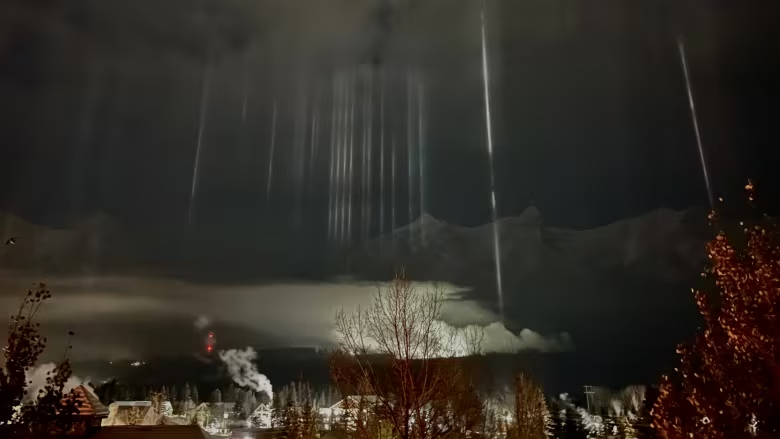
Similarly, urban environments exhibit a hazy quality because of air pollution and particulate matter. This haze can transform ordinary streetlights or building illumination into mesmerizing displays of volumetric lighting. The glow of streetlights can appear softer and more diffused, creating a dreamlike atmosphere that invites exploration.
In architectural contexts, volumetric lighting can dramatically enhance the visual appeal of a space. For instance, when light filters through windows or skylights, it can create stunning patterns and shadows that add depth and interest to the environment. This interplay of light and architecture not only beautifies a space, but also influences how people feel within it, making it a powerful tool in design.
A prime example is the Grand Central Terminal in New York City. In the 1930s and 40s, people widely celebrated Grand Central for its mesmerizing exhibition of sunbeams gracefully filtering through its vast windows. This resulted in a truly awe-inspiring spectacle of light and shadow that gracefully danced within the walls of this historic structure.

Photographers and cinematographers have long exploited these atmospheric conditions to capture captivating images and cinematic scenes. The interplay of light and atmosphere can tell stories that words alone cannot convey, drawing viewers into a deeper understanding of the environment.
Artistic applications of volumetric lighting
Having explored the natural occurrences of volumetric lighting, let’s delve into the applications of this technique in various artistic fields. From film and photography to video games and virtual reality, volumetric lighting plays a crucial role in shaping the viewer’s experience.
In theatrical productions
Within theatrical lighting, the skillful manipulation of light and atmosphere has always intertwined with the art of storytelling. The theater community refers to volumetric lighting as atmospheric lighting effects. These effects have become an indispensable tool for creating immersive environments, evoking emotions and enhancing the narrative experience. The ability to shape light allows creators to craft scenes that resonate with audiences on multiple levels.
Theatrical productions are not merely visual spectacles; they are carefully crafted worlds designed to transport audiences into realms of imagination and emotion. Proper usage of atmospheric effects plays a crucial role in achieving this transportive effect that can evoke feelings of joy, fear or nostalgia. Lighting designers apply this technique to sculpt the space with light, guiding the audience’s attention and hiding objects that need to appear as if by magic.
In film and photography
In film, volumetric lighting is often used to create mood and atmosphere. Directors and cinematographers implement this technique to evoke emotions, enhance storytelling and guide the audience’s focus. For example, a scene set in a foggy forest may use volumetric lighting to create an eerie ambiance, drawing viewers deeper into the narrative.
Photographers also harness the power of volumetric lighting to add drama and depth to their images. By capturing light filtering through trees or illuminating dust particles in the air, they can create striking compositions that resonate with viewers. This technique allows photographers to transform ordinary scenes into captivating visual stories.

Citizen Kane
In Citizen Kane, Orson Welles uses haze and fog as lighting effects to enhance the film’s atmosphere and thematic elements. The application of fog in various scenes creates a sense of mystery and ambiguity, often shrouding characters or settings in a veil that adds depth to the narrative. For instance, haze is used to soften the edges of the environment and focus attention on specific characters or objects, heightening their significance. This technique also contributes to the film’s exploration of themes, such as the obscured nature of truth and the complexity of human emotions. Welles’ innovative use of haze and fog lighting effects was pioneering, adding a layer of psychological and visual depth to the film.
Fan Ho – Photographer
Fan Ho’s photographic style is renowned for its masterful use of light and shadow, creating a distinct and atmospheric quality in his images. By shooting during the early morning or late afternoon, Ho captures dramatic lighting effects that enhance the mood and depth of his scenes. His compositions often feature fog, smoke and shadows, which infuse the bustling streets of mid-century Hong Kong with a cinematic and evocative atmosphere. This atmospheric quality highlights his careful framing and the interplay between light and darkness, which vividly portrays the city’s transformation and the essence of its people.

In video games and virtual reality
In the realm of video games, volumetric lighting is essential for creating immersive environments. Game developers use this technique to simulate realistic lighting conditions, enhancing the overall gameplay experience. For instance, in a horror game, volumetric lighting can create tension by casting eerie shadows and highlighting certain areas, guiding players through the narrative.
Volumetric lighting can signify important gameplay elements. For example, light beams may surround a glowing object, drawing the player’s attention and suggesting significance. This not only enhances the visual appeal but also aids in gameplay mechanics, making the experience more engaging.
As virtual reality (VR) technology continues to develop, volumetric lighting has become increasingly important in creating realistic and immersive experiences. In VR environments, the ability to simulate natural lighting effects can significantly enhance the sense of presence and realism. Users can feel as though they are truly part of the virtual world, interacting with light and shadow in a way that mimics real life.


Tim Sweeny and Unreal Engine
Tim Sweeney’s Unreal Engine has been a pioneer in the realm of volumetric lighting and haze effects, which have become hallmarks of its evolution. The first version of Unreal Engine introduced a revolutionary feature called real-time volumetric fog, which added depth and realism to 3D environments by simulating atmospheric conditions.
By enhancing pixel-level lighting and incorporating complex haze effects, Unreal Engine 3 continued to innovate, ultimately enhancing the visual richness and immersion of gaming experiences. Unreal Engine 4 introduced further advancements, including a more sophisticated particle system that refined haze and lighting interactions. Carrying the legacy of pioneering technologies that support more intricate and dynamic lighting effects, Unreal Engine 5 includes high-resolution LED screens used in virtual production for films, proving the engine’s ongoing leadership in atmospheric visual effects.
Installation art
Beyond the realms of theater and film, volumetric lighting has also found a captivating canvas in the world of installation art. Contemporary artists have embraced this technique to transform ordinary spaces into extraordinary, immersive environments, challenging traditional notions of art and inviting viewers to engage with light profoundly and viscerally.
The 9/11 Memorial at the World Trade Center
One of the most poignant examples of volumetric lighting in installation art is the National September 11 Memorial in New York City. Designed by architect Michael Arad and landscape architect Peter Walker, this memorial features two massive reflecting pools occupying the footprints of the former Twin Towers.

The lighting design, meticulously crafted by the renowned firm Fisher Marantz Stone, employs a sophisticated system of LED luminaires submerged within the pools. These fixtures project beams of light through the cascading waterfalls, creating a mesmerizing display of volumetric lighting that enhances the reflective atmosphere of the memorial.
Through the interplay of light, water and atmospheric conditions, the 9/11 Memorial transforms into a powerful and emotionally resonant installation, inviting visitors to contemplate the profound impact of the tragic events while being enveloped in a captivating display of light and shadow.
BorderTuner: Bridging borders with light
In a thought-provoking installation titled “BorderTuner,” Canadian-Mexican artist Rafael Lozano-Hemmer delved into the complex concept of borders and the essence of human connection through the innovative medium of volumetric lighting. This interactive work spanned the border between the United States and Mexico, featuring three interactive stations on each side, each equipped with powerful searchlight beams that illuminated the night sky.
Visitors to the installation had the unique opportunity to control these beams using a simple dial. When the lights from any two stations aligned, a sophisticated computer system would activate, enabling real-time communication between the operators situated across the border. This interaction was not merely technical; it fostered a sense of shared experience and connection. The volume of the users’ voices directly influenced the intensity of the light beams, creating a dynamic and responsive display of volumetric lighting that transcended physical boundaries. As participants spoke louder, the beams would intensify, visually representing their voices and emotions.

“BorderTuner” not only showcased the mesmerizing visual impact of volumetric lighting but also served as a poignant commentary on the interconnectedness of human experiences. It challenged traditional notions of borders, which often symbolize division and separation and instead fostered a sense of unity through the shared experience of light. The installation encouraged viewers to reflect on communication and connection in a world where borders can often feel insurmountable. By transforming light into a medium of dialogue, Lozano-Hemmer invited participants to consider how technology can bridge gaps and foster understanding between diverse communities.
Why employ atmospherics and lighting effects
This technique plays a crucial role in achieving a transportive effect by creating a sense of depth, mood and atmosphere that resonates with the storytelling.

By illuminating the very medium through which light travels, volumetric lighting allows directors, cinematographers and lighting designers to sculpt space with light, guiding people’s attention and evoking specific emotional responses. From the eerie glow of a haunted mansion to the warm embrace of a cozy living room, or the otherworldly ambiance of a science fiction setting, volumetric lighting shapes the emotional landscape of a scene, enhancing the narrative’s impact.
Let’s explore why theatrical and cinematic productions employ volumetric lighting techniques.
Creating immersion
Atmospherics play a crucial role in creating immersive environments across various media.
- Theater: Designers use fog, haze and strategic lighting to blur the boundaries between the stage and the audience, drawing viewers into the world of the play.
- Film: Cinematographers employ atmospheric effects to establish a sense of place and time, making scenes feel more realistic or fantastical as needed.
- Video Games: Game artists use particle systems and lighting effects to create dynamic, responsive environments that players can interact with, enhancing the overall gaming experience.
Enhancing mood and emotion
Atmospheric elements are powerful tools for setting and manipulating emotional tones.
- Color temperature: Warm or cool lighting can instantly change the mood of a scene, evoking comfort or unease.
- Density: Thick fog can create tension and mystery, while light haze can add a dreamy quality to a romantic scene.
- Movement: Swirling mist or drifting smoke can add a sense of dynamism or foreboding to a static set.
Guiding attention
Directors and designers use atmospherics to direct the audience’s focus.
- Spotlight effects: In theater and film, volumetric lighting can create visible beams that guide the eye to important characters or objects.
- Depth cues: In video games, atmospheric perspective (objects appearing hazier in the distance) helps players understand spatial relationships.
- Revealing/concealing: Selective use of fog or shadows can gradually reveal plot elements or hide potential threats, building suspense.
Adding texture and depth
Atmospherics provide visual richness and dimensionality.
- 3D space: In 2D media like film and volumetric effects help create the illusion of three-dimensional space.
- Visual complexity: In video games, particle systems add detail and movement to otherwise static environments.
- Light interaction: Visible light beams interacting with atmospheric particles create stunning visual effects that add layers of interest to a scene.
Symbolism and metaphor
Atmospheric effects often carry symbolic weight.
- Fog: Can represent confusion, the unknown or a blurring of reality.
- Shafts of light: Might symbolize hope, divine presence or revelation.
- Smoke: Could represent destruction, transformation or obscured truths.
Technical advantages
Beyond aesthetics, atmospherics offer practical benefits.
- Hiding limitations: In theater and low-budget films, fog can hide set boundaries or mask simple props.
- Softening visuals: In video games, atmospheric effects can soften the harsh edges of 3D models, making scenes look more natural.
- Transitional tool: Fog or fade effects can smooth scene transitions in all media.
Historical and genre authenticity
Atmospherics help establish periods and genre conventions.
- Period pieces: Smoke-filled rooms can evoke noir films or Victorian London.
- Science fiction: Laser beams cutting through misty air are a staple of the genre.
- Horror: Dense fog is almost synonymous with creating a spooky atmosphere.
By skillfully employing these atmospheric techniques, creators across various media can craft rich, evocative environments that not only look visually stunning but also serve the narrative, emotional and thematic needs of their projects. Whether it’s the pea-soup fog of a London street in a Sherlock Holmes play, the god rays streaming through trees in a fantasy video game or the smoky haze of a film noir detective’s office, atmospherics are indispensable tools in the artist’s arsenal for creating interesting and immersive experiences.
Creating volumetric lighting
Achieving effective volumetric lighting in theatrical and cinematic settings requires a combination of technical expertise and artistic vision. The key elements involved in this process include:
- Atmosphere generation: To create volumetric lighting effects, suspended particles, such as fog or haze, fill the performance space. By introducing specialized atmospheric generators or by utilizing natural atmospheric conditions, such as smoke or dust.
- Light source selection: The choice of light source is crucial for achieving the desired volumetric lighting effects. Narrow-beam, high-intensity light sources, such as spotlights or focused LED fixtures, create defined light beams that interact with the atmospheric medium more effectively.
- Beam shaping and control: Skilled lighting designers employ a variety of techniques to shape and control the light beams, including the use of barn doors, flags and gobos. These tools allow for precise sculpting of the light, creating intricate patterns, shadows and textures that enhance the overall visual impact.
- Integration with scenography: Volumetric lighting is not merely an isolated effect; it is an integral part of the overall scenographic design. Lighting designers work closely with set designers, directors and other creative teams to ensure that the volumetric lighting seamlessly integrates with the visual narrative, enhancing the storytelling and creating a cohesive, immersive experience.

Through the masterful combination of these elements, theatrical and cinematic productions can transport audiences into worlds of wonder, where light becomes a tangible presence, shaping emotions and guiding the narrative journey.
Architectural applications: Rendering realism through volumetric lighting
In the realm of architecture and design, volumetric lighting has emerged as a powerful tool for creating realistic and immersive visualizations. As technology continues to advance, architects and designers increasingly turn to advanced rendering techniques, such as ray tracing, to simulate the behavior of light and its interaction with various materials and atmospheric conditions. This shift has revolutionized the presentation and understanding of architectural concepts.

Light tracing rendering: Unveiling the beauty of illumination
Ray tracing is a sophisticated rendering technique that meticulously traces the path of light rays as they interact with virtual environments. This process produces images with unparalleled realism, allowing architects to visualize their designs in a way that closely resembles how they would appear in the real world. By simulating the physics of light, ray tracing enables the creation of photorealistic renderings that accurately depict the effects of volumetric lighting, including shadows, reflections and refractions.
The ability to visualize how light interacts with different surfaces and materials is crucial for architects. It allows them to make informed design decisions that enhance the aesthetic and functional qualities of their projects. For instance, understanding how natural light will enter a space can influence the placement of windows and the choice of materials, ultimately leading to more sustainable and visually appealing designs. As a result, volumetric lighting techniques have become essential in the architectural design process, providing a deeper understanding of how light shapes our built environment.
Designing for atmospheric installations
In addition to advanced rendering techniques, architects and designers are exploring the potential of incorporating volumetric lighting into built environments. By carefully considering the expected atmospheric conditions, such as natural light, smoke or haze, they can design spaces that heighten the impact of volumetric lighting effects. This thoughtful approach allows for a more immersive experience, where the interplay of light and atmosphere creates a unique ambiance.
For instance, the design of a church or spiritual space may include the potential for incense smoke to create captivating volumetric lighting displays. This not only enhances the sense of reverence and spirituality but also invites visitors to engage with the space on a deeper emotional level. Similarly, the design of a sauna or spa facility could incorporate strategic openings or skylights to allow sunbeams to pierce through the steam, creating a serene and rejuvenating atmosphere that promotes relaxation and well-being.
However, it is crucial to consider local fire codes and regulations when incorporating atmospheric elements into interior spaces. Strict guidelines often govern the use of smoke, haze or fog machines, ensuring the safety of occupants and preventing potential hazards. By adhering to these regulations, designers can create visually stunning environments while prioritizing the safety and comfort of those who inhabit them.

Conclusion: Embracing the radiant realm
By understanding the principles of volumetric lighting, creators can craft immersive environments that resonate with audiences. Inviting them to engage with the narrative on a deeper level. This level of precision empowers architects and designers to convey their designs convincingly, aiding in client presentations, project evaluations and marketing materials. The ability to depict volumetric lighting effects accurately, such as the subtle interplay of sunbeams filtering through windows or the dramatic impact of spotlights in a theater setting, allows stakeholders to experience the intended atmosphere and ambiance of a space before building. This capability not only enhances the visual appeal of the designs but also fosters a deeper understanding of how light can influence the perception of space.
As technology continues to develop and creative minds push the boundaries of what is possible, the realm of volumetric lighting will continue to expand. This expansion offers new avenues for storytelling, emotional expression and architectural innovation. Embracing these avenues not only enhances visual communication but deepens the connection to the surrounding world.


